

Age shows up in the eyes before anywhere else. Not dramatically, not all at once — but gradually, the upper lids start to hang a little lower, the lower lids develop puffiness that sleep does not fix, and the overall effect is that face looks tired all the time. For a lot of women in Dubai, this is the point where eyelid surgery stops being a vague idea and starts being something worth researching seriously.
This guide covers the full picture: what eyelid surgery actually involves, how the different procedures differ, what the recovery looks like, and what separates a good outcome from a bad one.
What Is Eyelid Surgery and When Does It Make Sense
Eyelid surgery — medically called blepharoplasty — removes or repositions excess skin, fat, and muscle around the eyelids. It can be performed on the upper lids, lower lids, or both, depending on what’s causing the problem.
There are two distinct reasons people pursue it. The first is functional: when drooping upper eyelids obstruct the visual field to a clinically meaningful degree. The second is cosmetic: restoring a rested, alert appearance that the person feels they have lost. Usually many patients have both concerns at once — the drooping is real and the aesthetic impact bothers them equally.
The American Society of Plastic Surgeons consistently ranks blepharoplasty among the top five most commonly performed cosmetic surgical procedures globally. It’s not a fringe surgery. It’s also not one where results are guaranteed to look natural — the difference between a good blepharoplasty and an overdone one is mainly in the surgeon’s judgment and technique.
Cosmetic Eyelid Surgery in Dubai — Understanding Your Options
The term “eyelid surgery” covers more than one procedure, and the right choice depends on what’s actually happening anatomically.
Upper Blepharoplasty
This addresses excess skin on the upper lid — the skin that folds over the lash line, creates a hooded appearance, or in more pronounced cases drops low enough to narrow the field of vision. The surgery removes the excess tissue through an incision placed in the natural crease of the upper lid, which makes the resulting scar virtually invisible once healed.
Upper blepharoplasty is probably the most common form of cosmetic eyelid surgery in Dubai. It’s relatively has a manageable recovery period, and tends to produce results that look natural — provided the surgeon is conservative about how much tissue is removed.
Lower Blepharoplasty
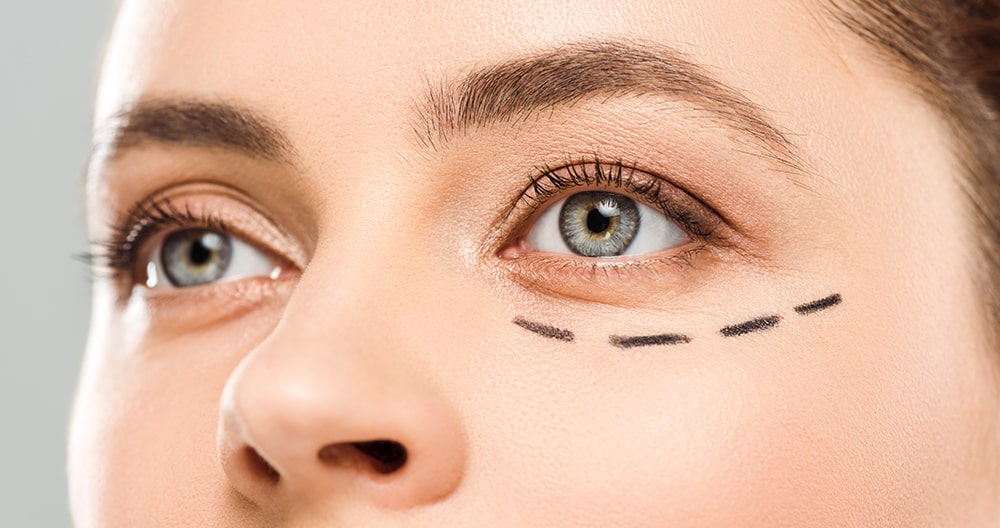
Lower lid surgery addresses under-eye bags, puffiness, and loose skin below the eye. This is technically more demanding than upper lid surgery. The lower lid is structurally more complex and more unforgiving of overcorrection — removing too much tissue or fat can cause the lower lid to pull downward (ectropion), which is both cosmetically poor and potentially damaging to the ocular surface.
The two main approaches are transcutaneous (through an external incision just below the lash line) and transconjunctival (through the inner surface of the lid, leaving no external scar). The transconjunctival approach is preferred when the concern is primarily fat herniation without significant skin laxity, as it avoids the external incision entirely.
Ptosis Repair
Ptosis is drooping of the upper lid caused by weakness or stretching of the levator muscle — the muscle responsible for lifting the lid. This is a different problem from dermatochalasis and requires a different surgical approach. The two are often confused, and occasionally both are present simultaneously.
Misidentifying ptosis as simple skin excess and treating it with standard blepharoplasty produces poor results. A surgeon who specializes in both oculoplastics and ophthalmic surgery will correctly identify which condition is present before planning treatment.
Brow Ptosis
Sometimes what looks like excess upper eyelid skin is actually the brow sitting lower than it should. Removing upper lid skin in these cases can leave a patient with eyes that feel tight or look distorted, because the underlying cause wasn’t addressed. Evaluating brow position is part of any thorough pre-operative assessment for upper lid surgery.
Eyelid Lift Surgery in Dubai — The Surgical Process at Orbit Eye Center
At Orbit Eye Center, the process for eyelid lift surgery starts well before any procedure is scheduled.
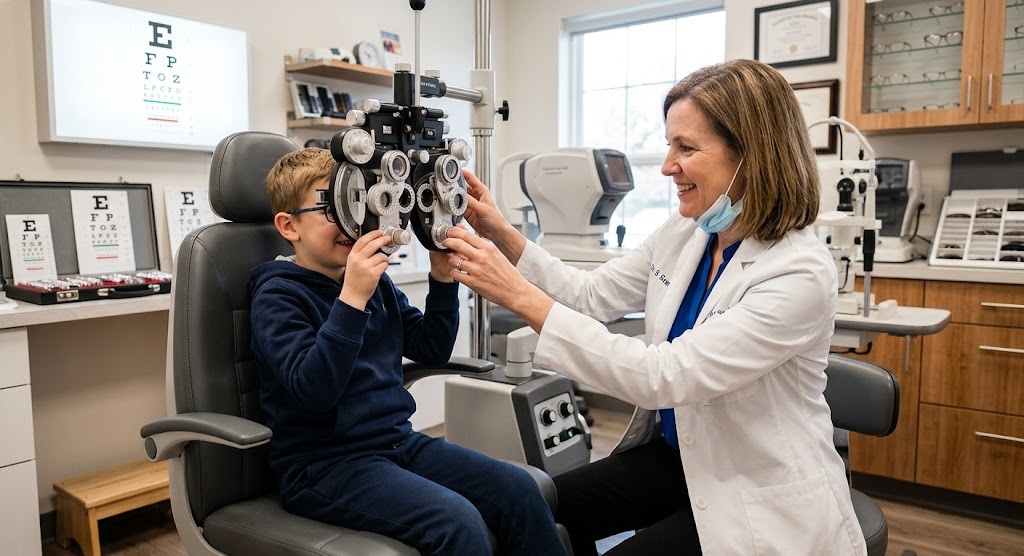
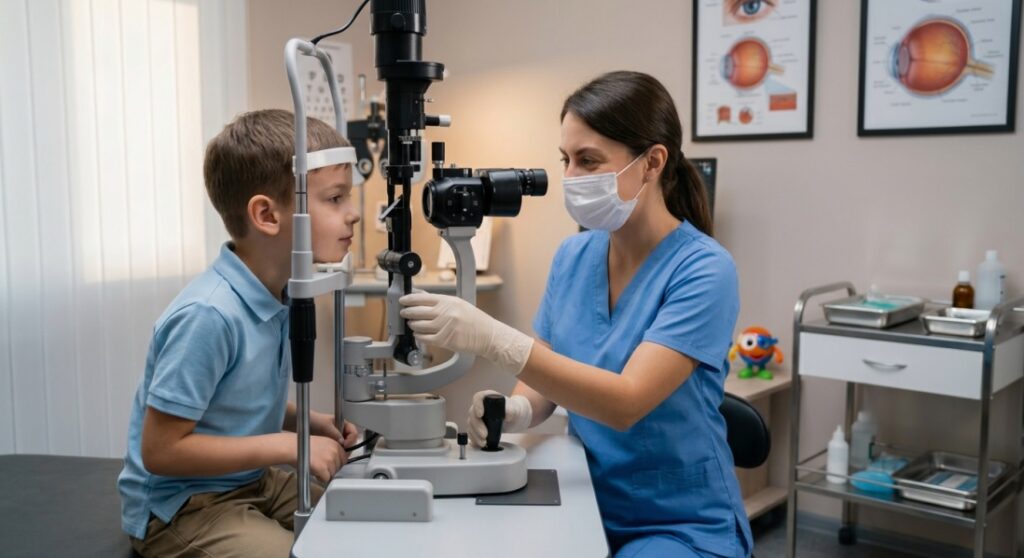
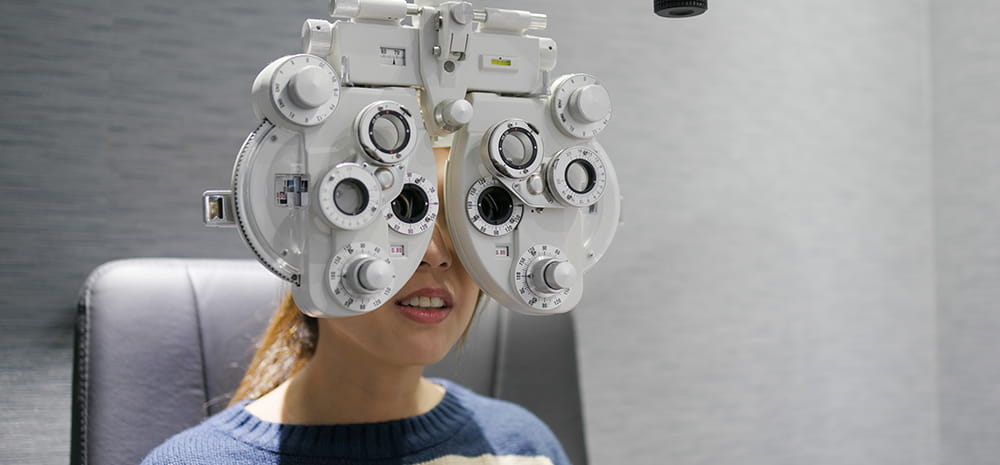
The initial consultation involves a detailed clinical examination: measuring lid position, assessing levator muscle function, evaluating the degree of skin excess, and examining the eye itself — including the cornea and tear film — because eyelid surgery affects ocular surface health and a patient with pre-existing dry eye needs to know that going in.
Photographs are taken in consistent lighting. The surgeon reviews what’s anatomically present, what’s achievable, and what the risks look like for that specific patient. This is the conversation where the plan is actually made — not a template applied to everyone who walks in wanting fresher-looking eyes.
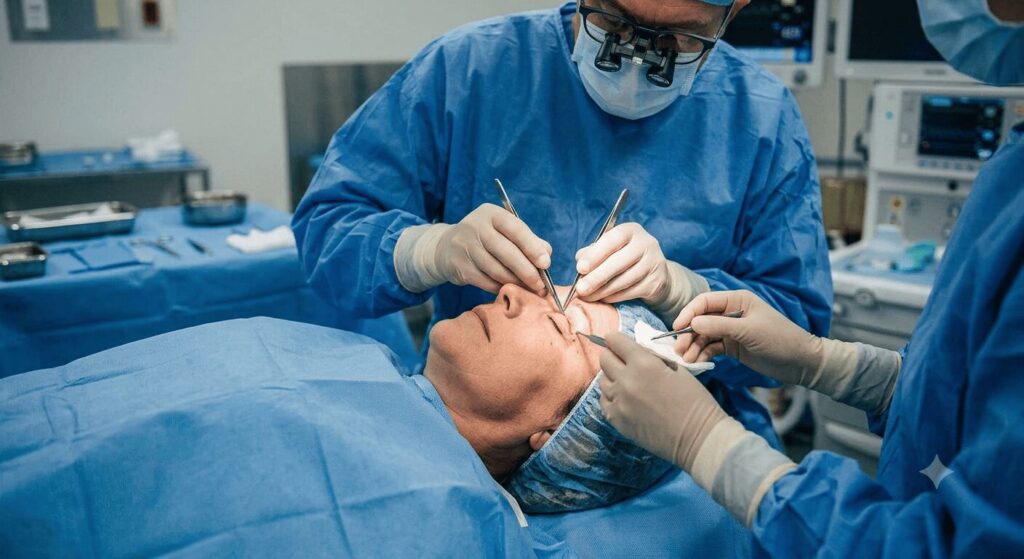
Surgery itself is typically performed under local anaesthesia with sedation, as a day-case procedure. Most patients are at the clinic for two to three hours in total, with the surgical portion taking considerably less time than that.
Upper blepharoplasty generally takes 45 minutes to an hour. Lower blepharoplasty takes longer and varies more depending on technique. Combined upper and lower lid procedures extend the time accordingly.
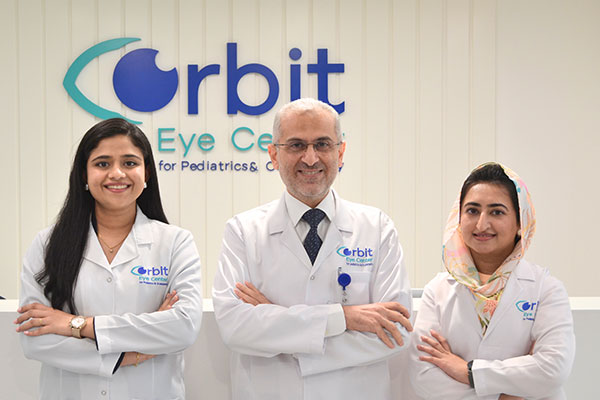
Orbit’s surgical team includes oculoplastic specialists — surgeons who trained specifically at the intersection of ophthalmology and plastic surgery of the periorbital area. This matters because the eye itself is not a spectator in eyelid surgery. Corneal protection, lid closure, and tear film are all affected by what happens to the lids, and a surgeon who understands ocular anatomy at that level will make different decisions than one who doesn’t.
Droopy Eyelid Correction in Dubai — Functional vs. Cosmetic
Droopy eyelid correction in Dubai can be approached as a cosmetic procedure, a functional one, or both — and the distinction affects not just the surgical plan but also how the procedure may be covered under insurance.
Dermatochalasis — where the drooping is genuinely obstructing vision — can sometimes qualify for medical insurance coverage. This requires documented visual field testing showing the degree of obstruction. At Orbit, this testing can be performed as part of the pre-operative workup, and the clinical team can help patients understand whether their presentation meets the threshold for functional classification.
For women who are primarily concerned with the cosmetic impact — tired-looking eyes, a heavy brow, asymmetry between the lids — the approach is cosmetic blepharoplasty or ptosis repair depending on the cause, with a realistic discussion of what can and cannot be achieved.
The British Oculoplastic Surgery Society (BOPSS) guidelines note that the most common cause of dissatisfaction after blepharoplasty is expectation mismatch — patients who expected a result that wasn’t achievable given their anatomy, or who weren’t clearly told about the risks. This is why the consultation process at Orbit is thorough rather than a formality.
Laser Blepharoplasty in Dubai — What It Means and When It’s Used
The phrase “laser blepharoplasty” comes up often in Dubai, and it’s worth explaining what it actually means. It doesn’t describe a fundamentally different procedure — it describes a technique for making incisions and managing tissue using a CO2 or erbium laser instead of a traditional scalpel.
The potential advantages of laser use in eyelid surgery include:
- Reduced bleeding during the procedure, because the laser simultaneously cuts and cauterizes
- Potentially less bruising and swelling in the early post-operative period
- Some degree of skin tightening from the thermal effect
Laser blepharoplasty in Dubai is offered at Orbit for appropriate candidates. Whether laser or conventional technique is used depends on the specific procedure and the patient’s anatomy. For transconjunctival lower blepharoplasty in particular, CO2 laser is well-suited. The choice of instrument matters less than the skill and judgment of the surgeon using it — this point is worth keeping in mind when evaluating clinics that emphasize laser technology as a headline feature.
Recovery: What the First Two Weeks Actually Look Like
Blepharoplasty recovery is better than most patients expect and worse than the most optimistic descriptions online. A realistic account:
Days 1–3: Swelling and bruising will be at their peak. Cold compresses help. Sleeping with the head elevated reduces fluid pooling around the eyes. The eyes may feel dry or irritated. Vision may be temporarily blurry from lubricating drops. Most patients are surprised by how significant the swelling looks at this stage.
Days 4–7: Bruising begins to shift and fade. Sutures are typically removed around day five to seven for external incisions. Swelling improves noticeably. Most patients at this point look like they’ve had an injury rather than surgery.
Weeks 2–4: Presentable in public for most purposes, with some residual swelling and subtle bruising that makeup can cover. Some patients return to desk work within a week to ten days; activities involving physical exertion take longer.
Three to six months: This is when the final result settles. Early scarring, minor asymmetry, and skin texture changes all continue to improve through this period. The scar in the upper lid crease typically fades to near-invisible over six months.
The American Academy of Ophthalmology notes that dry eye is a real post-operative concern — particularly in patients who already have marginal tear production before surgery. This is one reason pre-operative ocular surface assessment matters.
What Women Specifically Should Know Before Eyelid Surgery
Most patients seeking cosmetic eyelid surgery are women, and a few considerations come up repeatedly in consultations at Orbit.
Makeup timelines matter. Eye makeup should be avoided for at least two weeks post-operatively, and in some cases longer depending on healing. This is a practical consideration for women who rely on eye makeup professionally or socially.
Hormonal factors. Fluid retention associated with hormonal fluctuations can affect swelling in the early recovery period. Scheduling surgery to avoid the few days before menstruation, when fluid retention tends to peak, is a small but worthwhile consideration.
Realistic goals. Surgery restores the eye area to something closer to its earlier appearance — it doesn’t transplant someone else’s eyes onto your face. The goal is to look like a rested, refreshed version of yourself. Patients who go in with that frame of mind tend to be more satisfied than those chasing a specific appearance from a photograph.
Asymmetry. Most people’s eyes are already slightly asymmetric before surgery. Eyelid surgery doesn’t eliminate pre-existing asymmetry and can occasionally make a subtle difference more noticeable. A thorough pre-operative discussion includes an honest assessment of existing asymmetry and what’s realistic to correct.
How to Find Good Eyelid Surgery Clinic in Dubai
The aesthetic medical market in Dubai is large and ranges enormously in quality. For eyelid surgery specifically — a procedure that is both delicate and permanent — a few filters help narrow the field.
The surgeon should have training in oculoplastics or ophthalmic plastic surgery, not just general plastic surgery or cosmetic medicine. The distinction matters because oculoplastic surgeons understand the eye as an organ, not just as a structure with skin around it.
The clinic should perform pre-operative visual field and ocular surface testing, not just take photographs. The consultation should be substantive enough to address your specific anatomy, not a 15-minute sales conversation.
Orbit Eye Center meets these criteria. The team includes oculoplastic surgeons with formal subspecialty training, the assessment process is thorough, and the clinic’s ophthalmology background means the eye itself is never treated as incidental to the procedure.
Frequently Asked Questions
Is eyelid surgery safe?
Yes — blepharoplasty has a well-established safety profile when performed by a qualified surgeon on an appropriately selected patient. Serious complications are uncommon. The risks include temporary dry eye, asymmetry, infection, and scarring, all of which are manageable in the majority of cases. The most serious potential complication — vision loss — is extremely rare and almost always related to retrobulbar haematoma, which occurs in less than 0.04% of cases according to published literature in the Aesthetic Surgery Journal. Having surgery performed by a surgeon with ophthalmic training specifically reduces this risk, because intraocular pressure management and orbital anatomy are within their primary scope of practice.
How long does eyelid surgery take?
Upper blepharoplasty alone typically takes 45 to 60 minutes under local anaesthesia with sedation. Lower blepharoplasty takes 60 to 90 minutes depending on the technique used. Combined upper and lower procedures take roughly two hours. The total time at the clinic, including preparation and recovery observation, is usually two to three hours. Eyelid surgery is a day procedure — you go home the same day.
Is blepharoplasty painful?
Not during the procedure. Local anaesthesia is administered before any incisions are made, and most patients describe the injections as the most uncomfortable part — brief, sharp, over quickly. During surgery, there may be mild pressure or tugging sensations but not pain. Post-operatively, most patients describe the discomfort as mild and well-controlled with standard analgesics. The predominant experience in the first few days is swelling and tightness rather than pain. Significant post-operative pain that isn’t controlled by paracetamol and ibuprofen should prompt a call to the clinic, as it can indicate a complication.
What age is best for eyelid surgery?
There’s no single right age — the right time is when the anatomy warrants it and the patient’s overall health supports it. Most patients presenting for upper blepharoplasty are in their late 30s to 60s, but some younger patients have significant hereditary hooding that causes functional or cosmetic concern earlier. For purely cosmetic cases, the Royal College of Surgeons of England recommends ensuring that the changes are stable — that the patient isn’t in a phase of rapid anatomical change that would quickly alter the result. For functional ptosis in younger patients, earlier intervention may be appropriate to protect vision. There is no upper age limit for blepharoplasty provided the patient is medically fit for the procedure.